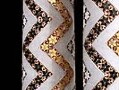
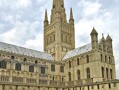
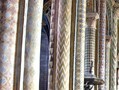
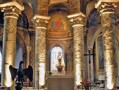

-
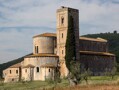
Abbey of Sant Antimo
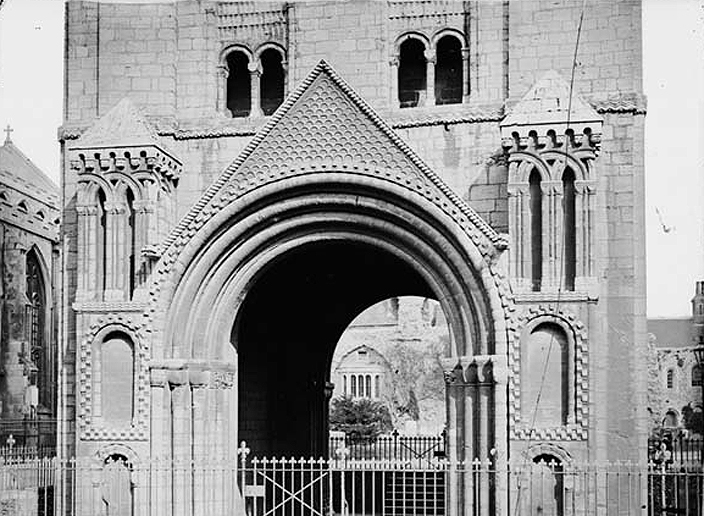
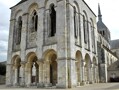
Exterior view of the abbey of Sant Antimo, Tuscany, Italy, 1120. (For more information about the building see Paradox Place).
This Benedictine abbey is a text-book example of Romanesque architecture, with its square tower, solid construction, and small, round-arched windows.
The abbey was the most important foundation in Tuscany. It had imperial connections, was on the route to Rome, and had extensive landholdings. It has an interesting historic parallel to Durham: The abbot was so powerful that he held the title of Earl Palatine, and had similar secular authority as the Prince Bishops of Durham.
© Paradox Place
-
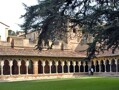
Abbey of St Pierre de Moissac
The cloisters at the Abbey of St Pierre de Moissac, France. Completed in 1100. (For more information about the building see Paradox Place).
The cloisters of Moissac have an airiness similar to that of the arcades of the Galilee Chapel of Durham Cathedral built almost a century later, (see next image) and both have much in common with the architecture of Islamic Spain.
© Adrian Fletcher
-
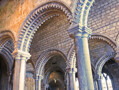
Galilee Chapel, Durham Cathedral
Arcades of the Galilee Chapel, Durham Cathedral, 12th century.
The graceful arcades of the Galilee Chapel at Durham Cathedral were possible because, unlike the rest of the building, they do not support a heavy or massive superstructure.
In inspiration, they seem to draw much from the architecture of Muslim Spain.
© Michael Sadgrove
-
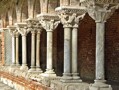
Abbey of St Pierre de Moissac
Detail of the cloisters at the Abbey of St. Pierre de Moissac, France. Completed circa 1100. (For more information about the building see Paradox Place).
The capitals of the columns in the cloisters at Moissac are among the earliest and finest examples of figural stone carving in Romanesque architecture. They narrowly escaped demolition at the end of the nineteenth century to make way for a railway line!
© Adrian Fletcher (www.paradoxplace.com)
-
Abbey of St Pierre de Moissac
Capital depicting St Martin of Tours cutting his cloak in two to give half to a pilgrim, Abbey of St Pierre de Mossaic, France, circa 1100. (For more information about the building see Paradox Place).
© Adrian Fletcher, (www.paradoxplace.com)
-
Abbey of St Pierre de Moissac
Detail of the stone pier in the doorway of the Abbey of St Pierre de Moissac, France, circa 1100. (For more information about the building see Paradox Place).
The carving depicts St Jeremiah, and is remarkably well preserved. Both the detail, and the expressive manner in which the scene is depicted indicate that the sculptor was truly a master. It is thought that he also worked in Spain, at the monastery of St Domingo de Silos. Then as now, exceptionally talented individuals were much sought after, and thus applied their skills around the world.
© Adrian Fletcher, (www.paradoxplace.com)
-
Abbey of St Pierre de Moissac
View of the nave of the abbey of St Pierre de Moissac, France, circa 1100. (For more about the building see Paradox Place).
The repetitive patterns of the wall painting seen here are extremely similar to traces of paint found in the side aisles of Durham Cathedral. They remind us of a fact often forgotten: that the interiors of most Romanesque buildings would have originally been very colourful.
© Adrian Fletcher, (www.paradoxplace.com)
-
Abbey of St Pierre de Moissac, France
Capital depicting Daniel in the Lion's Den, abbey of St Pierre de Moissac, France, circa 1100. (For more information about the building see Paradox Place).
© Adrian Fletcher, (www.paradoxplace.com)
-
Amalfi Cathedral
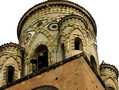
The bell-tower of Amalfi Cathedral, Italy, originally built between 1180 and 1276 (but partially reconstructed in the 19th century). (For more information about the building see Paradox Place).
There are two striking similarities with Durham Cathedral: the intersecting arches, and the lozenges (diamond shapes) at the top of the belltower. (See next image).
© Adrian Fletcher (www.paradoxplace.com)
-
Exterior, Durham Cathedral
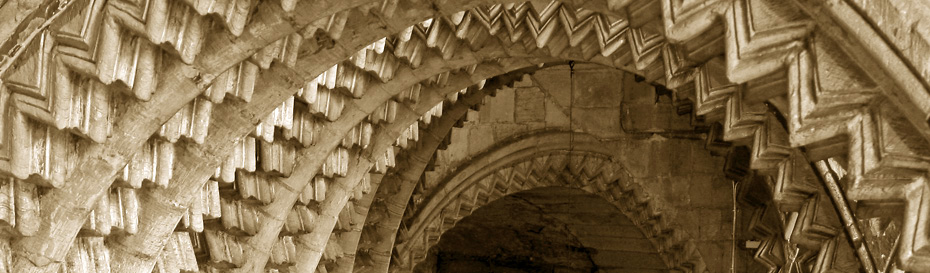
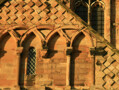
Detail of the stone carving on the exterior of Durham Cathedral. Circa 1100.
The use of lozenges (diamond shapes) and intersecting arches was common in Romanesque architecture. (See previous image). The combination of recessed and projecting lozenges, as seen here, would have been especially effective in sunny climates where the contrast between the recesses and the projections would have been striking. This pattern may have been seen in Spain and copied from there.
© Michael Sadgrove
-
Basilica of St Julian, Brioude
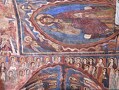
Detail of the painted vaulting at the Basilica of St Julian, Brioude, France, 11th-12th centuries. (For more information about the building see Paradox Place).
Romanesque architecture is often pleasing to contemporary eyes because of its austerity, especially in comparison to gothic architecture. In reality, most Romanesque religious buildings would have been heavily decorated, depicting religious scenes, not just in stone, but in paint as well.
© Paradox Place
-
Wall Painting in the Galilee Chapel
This wall painting in the Galilee Chapel at Durham Cathedral is very similar in style to those in other contemporary buildings around Europe. (See previous image).
-
Basilica of St Julian, Brioude
Interior of the Basilica of St Julian, Brioude, France, 11th-12th centuries. (For more information about the building see Paradox Place).
The frescos show an interesting combination of geometric patterns, and representative scenes. The drapery painted at the base of the columns is similar to that in the Galilee Chapel of Durham Cathedral. Paint did much to soften the effect of stone.
© Paradox Place
-
Bitonto Cathedral
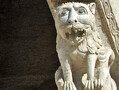
Detail of arcade, Bitonto Cathedral, Puglia, Italy, twelfth century.(For more information see Paradox Place).
Mythical creatures and fearsome beasts, such as this lion, appeared frequently in Romanesque architecture.
© Adrian Fletcher (www.paradoxplace.com)
-
Bitonto Cathedral
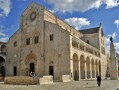
A view of the exterior of Bitonto Cathedral, Puglia, Italy, constructed in the 12th century. (For more information about the building see Paradox Place).
© Adrian Fletcher (www.paradoxplace.com)
-
Bitonto Cathedral
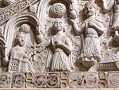
The pulpit of Bitonto Cathedral, Puglia, Italy. Probably 13th century. It depicts Frederick II, King of Sicily, a colourful character who became Holy Roman Emperor in 1215, at the age of 19, and his family. (For more information see Paradox Place).
© Adrian Fletcher (www.paradoxplace.com)
-
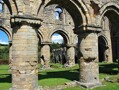
Buildwas Abbey
The ruins of Buildwas Abbey, Shropshire, built in the 1150s. (For more information about the building see Paradox Place).
One of the essential differences between Romanesque buildings like this one and later gothic buildings was that Romanesque architecture was much more robust -exemplified in the massive columns seen here. This was primarily due to the limits of architectural technology. Columns that were more slender probably would have been desirable, but the skills to construct them successfully had not yet been developed.
© Adrian Fletcher (www.paradoxplace.com)
-
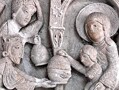
Cathedral of St. Lazare, Autun
Detail of the carving from the cathedral of St Lazare in Autun, France, built between 1120 and 1146. This scene shows the Adoration of the Magi (The three kings bringing gifts to the newly-born Jesus). (For more information about the building see Paradox Place).
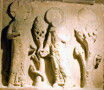
Durham Cathedral has fewer examples of figural representation than many other Romanesque buildings. However, a few remaining fragments from the stone Rood Screen which once stood in the transept indicates that the Cathedral once did have some figural carvings (See next image).
© Adrian Fletcher (www.paradoxplace.com)
-
Durham Cathedral Rood Screen
Fragment from the Rood Screen of Durham Cathedral, dating from around 1150. It shows the type of figural carving that would have once been found inside the Cathedral (but which was removed and often destroyed in the 16th century after the English Reformation).
© Jeffrey Veitch
-
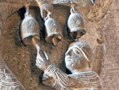
Cathedral of St. Lazare, Autun
Detail of a capital from the Cathedral of St Lazare, Autun, France, 12th century. (For more information about the building see Paradox Place).
Historic buildings need to be seen in the context of contemporary literary, artistic and musical traditions that were inseparable from the architecture itself. This expressive scene shows the Gregorian chants, which, by the twelfth century, were very much part of the musical traditions associated with the Church.
© Adrian Fletcher (www.paradoxplace.com)
-
Chiaravalle della Colomba Abbey
Detail from the cloister of the abbey of Chiaravalle della Colomba, Fidenza, Italy, circa 1135. (For more information about the building see Paradox Place).
These intersecting arches are similar to those in the nave of Durham Cathedral, (see next image) and are likely to have been influenced by the architecture of Muslim Spain.
© Adrian Fletcher (www.paradoxplace.com)
-
Durham Cathedral
Detail of the intersecting arches in the nave at Durham Cathedral, circa 1100.
The similarity of these arches to those in other buildings in Spain is testament to the cross-cultural influences that shaped medieval architecture, sometimes through the movement of craftsmen, at other times, because people travelled and returned home inspired by what they saw abroad.
(See previous and following image).
© Michael Sadgrove
-
Jafiriyya Palace, Saragossa
The exterior of the Jafiriyya Palace, Saragossa, Spain, 11th century.
The intersecting arches above the palace doorway are very similar to those in the nave of Durham Cathedral, seen in the previous image. The palace was built when Saragossa was under Muslim rule.
© archnet.org
-
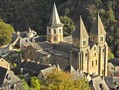
Church of St Foy, Conques
Exterior view of the Church of Sainte Foy at Conques, France, constructed between 1087 and 1107, and therefore contemporary with Durham Cathedral. (For more information about the building see Paradox Place).
In form, the western side of the church at Conques (with the two towers) resembles Durham Cathedral, which would have originally had the same type of spires.
© Adrian Fletcher (www.paradoxplace.com)
-
Church of St Foy, Conques
View of the nave of the church of St Foy, Conques, France. Constructed between 1087 and 1107 (for more information about the building see Paradox Place).
The nave of this church is almost contemporary with that of Durham Cathedral. It is covered with a simple stone vault, and due to the structural difficulties of building stone vaults, the nave is extremely narrow. It was the successful use of the pointed arches and more complex ribbed vaults at Durham Cathedral for the first time that enabled the vaults to span a much greater width, and achieve greater height. This paved the way for gothic architecture, making the soaring later churches and cathedrals of Europe possible.
© Adrian Fletcher (www.paradoxplace.com)
-
Church of St Pierre, Aulnay
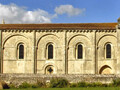
Exterior view of the Church of St Pierre, Aulnay, France, second half of the 12th century. (For more information about the building see Paradox Place).
© Adrian Fletcher (www.paradoxplace.com)
-
Church of St Pierre, Aulnay
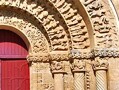
Entrance to the Church of St Pierre, Aulnay, France. Second half of the 12th century. (For more information about the building see Paradox Place).
© Adrian Fletcher, (www.paradoxplace.com)
-
Church of St Pierre, Aulnay
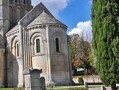
Apse of the Church of St Pierre, Aulnay, France, second half of the twelfth century. (For more information see Paradox Place).
The eastern end of Durham Cathedral would have looked similar before the construction of the Chapel of the Nine Altars in the mid-thirteenth century.
© Adrian Fletcher (www.paradoxplace.com)
-
Church of St Pierre, Aulnay
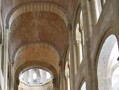
The nave of the Church of St Pierre, Aulnay, France, second half of the twelfth century. (For more information about the building see Paradox Place).
© Adrian Fletcher (www.paradoxplace.com)
-
Church of the Holy Trinity,Torri
Detail of the arcading in the cloister, Church of the Holy Trinity, Torri, Tuscany, 13th century (For more information about the building see Paradox Place).
The use of different materials to create contrast, and the reliance on geometric patterns and interlocking designs was common to both Romanesque and Islamic architecture. Note the checkerboard effect on the third column from the right. The deep carving creates areas of light and shadow that create striking patterns using a very simple pattern.
© Paradox Place
-
Ely Cathedral
The nave of Ely Cathedral, Cambridgeshire, late eleventh to late twelfth century, (For more information about the builkding see Paradox Place).
Apart from its nineteenth-century painted wooden ceiling, the nave of Ely Cathedral has much in common with that of Durham Cathedral. Both naves are almost contemporary.
© Adrian Fletcher (paradoxplace.com)
-
Fleury Abbey
The ambulatory of Fleury Abbey, France. Early twelfth century. (For more information about the building see Paradox Place).
This image gives some idea of what the area around the shrine of St Cuthbert at Durham Cathedral may have looked like before it was modified in the 13th century.
© Adrian Fletcher (paradoxplace.com)
-
Fleury Abbey
Detail of the choir of Fleury Abbey showing columns with figural carving. Early twelfth century. (For more information about the building see Paradox Place).
Many religious buildings from the Romanesque period, especially in France and Italy, had extremely detailed figural carving, often depicting biblical scenes. Fleury Abbey is a good example.
© Adrian Fletcher (paradoxplace.com)
-
Fleury Abbey
The Romanesque undercroft (space under a church) at Fleury Abbey, France. Early twelfth century. (For more information about the building see Paradox Place).
Romanesque undercrofts of this type have led to the suggestion that what it known as the Norman Chapel at Durham Castle was in fact an undercroft itself and not a chapel (See next image). Historic accounts seem to indicate that it was in fact a chapel though.
© Adrian Fletcher (www.paradoxplace.com)
-
Norman Chapel, Durham Castle
The interior of the Norman Chapel at Durham Castle, circa 1080.
-
Fleury Abbey
The portico at Fleury Abbey. Circa 1218. (For more information about the building see Paradox Place).
© Adrian Fletcher (www.paradoxplace.com)
-
Font in St Bridget's Church, Bridekirk
Detail of a stone font made circa 1150 and depicting its maker, Richard of Durham, in St Bridget's Church, Bridekirk. (For more information about the building see Paradox Place).
© Adrian Fletcher (www.paradoxplace.com)
-
Font in St. Bridget's Church, Bridekirk
A stone font made circa 1150 and depicting its maker, Richard of Durham, in St. Bridget's Church, Bridekirk. (For more information see paradoxplace).
© Adrian Fletcher, (www.paradoxplace.com)
-
Fountains Abbey
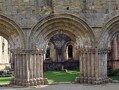
Ruins of Fountains Abbey, North Yorkshire, 1132. (For more information about the building see Paradox Place).
These round arches are typical of Romanesque architecture.
© Adrian Fletcher, (www.paradoxplace.com)
-
Gradefes Convent
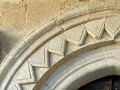
A doorway at Gradefes Convent, Spain, late twelfth century. (For more information about the building see Paradox Place).
The zig-zag pattern, known as the chevron, was common in Norman buildings, and seems to have been an Islamic influence. It appears in numerous places in Durham Cathedral, and is used to great effect in the Gallilee Chapel, built in the 1170s by Hugh le Puiset (see previous image). The chevron's effectiveness lies in its ability to visually break a solid mass, making a building seem lighter. (It functions in the same way a zebra's stripes do, for example).
© Adrian Fletcher, (www.paradoxplace.com)
-
Hereford Cathedral
The nave of Hereford Cathedral, 11th century onwards, (For more information about the building see Paradox Place).
This view of the nave shows the Romanesque arches of the Norman building at the lower level, but later gothic architecture above. The pointed arches and elaborate ribbed vaulting of gothic architecture seen in the ceiling of this nave developed from the first successful attempt to use both at Durham Cathedral.
© Adrian Fletcher (www.paradoxplace.com)
-
Lindisfarne Priory
The Ruins of Lindisfarne Priory, early twelfth century.
The arcades of Lindisfarne Priory, especially the pillars with a chevron (zigzag) design, are like a scaled-down version of those of Durham Cathedral. This is hardly surprising: The priory was refounded in the early twelfth century by the Durham-based community of St Cuthbert, after the building of the Cathedral. It is possible that the same masons worked on both buildings.
-
Lindisfarne Priory
A pillar at Lindisfarne Priory, dating from the early 12th century. (For more information about the building see Paradox Place).
Although heavily eroded, the chevron or zigzag design on this pillar is clear. As the Priory was refounded in the early twelfth century by the Durham-based community of St Cuthbert, it is likely it the same masons who built Durham Cathedral also worked here. This would explain the similarity in the details of the two buildings (such as the pillars). (See next image).
© Adrian Fletcher (www.paradoxplace.com)
-
Nave, Durham Cathedral
The geometric designs carved in the stone pillars of Durham Cathedral were common in Norman architecture. The specific details of these suggest that the masons who carved them also worked on Lindisfarne Priory to the North of Durham.
© Michael Sadgrove
-
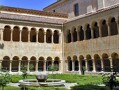
Monastery of Santo Domingo de Silos
The cloister of Santo Domingo de Silos, Northern Spain, 11th-12th century. (For more information about the building see Paradox Place).
In countries like Spain, warm weather meant that the arcades of the cloisters could remain open (unglazed). This enabled the use of arcaded columns such as the ones seen here. In places like Durham, where the cloisters needed to be glazed, they usually took the form of rows of large windows instead - an example of how climate can affect the way in which the same architectural feature is expressed.
© Paradox Place
-
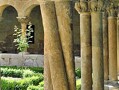
Monastery of Santo Domingo de Silos
Detail of the colonnade at the Monastery of Santo Domingo de Silos, Northern Spain, 11-12th centuries. (For more information about the building see Paradox Place).
Buildings like this were the work both of their patrons and craftsmen, both of whom often wanted to impress others with their work. The group of columns pictured here is likely to have been a craftsman's touch. It is an example of an eleventh-century mason showing off his skill.
© Paradox Place
-
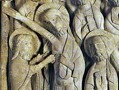
Monastery of Santo Domingo de Silos
Carved panel from the cloister at the Monastery of Santo Domingo de Silos, Spain, 12th century.
The carved panels in this building are thought to be the work of the same craftsman who worked on the Abbey of St. Pierre de Mossaic in France.
This is not unlikely: skilled craftsmen moved around from one project to another. Santo Domingo de Silos is on the much-travelled pilgrimage route to Santiago de Compostela in North-East Spain, which was dotted with important religious buildings, and would have been an obvious route for talented craftsmen in search of work to take.
© Paradox Place
-
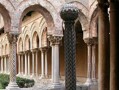
Monreale Cathedral Cloisters
View of the cloisters of Monreale Cathedral, Sicily, late 12th century. (For more information see about the building see Paradox Place).
The cloisters of Monreale Cathedral make heavy use of the chevron (zigzag) design, which appears in Durham Cathedral as well.
© Adrian Fletcher, (www.paradoxplace.com)
-
Monreale Cathedral
Detail of the columns in the cloisters of Monreale Cathedral, Sicily, late 12th century. (For more information about the building see Paradox Place).
The use of gold mosaic, popular in Byzantine art, never really died out, probably because its effect was so dazzling. In this example, the combination of several geometric patterns indicates a strong Islamic influence.
© Adrian Fletcher, (www.paradoxplace.com)
-
Norwich Cathedral
View of Norwich Cathedral, begun in 1096. For more information about the building see Paradox Place.
© Paradox Place
-
Notre Dame la Grande, Poitiers
The nave of Notre Dame la Grande, Poitiers, France, 12th century. (For more information about the building see Paradox Place).
It is often difficult to imagine that the interior of Romanesque churches would have originally been quite colourful. The geometric designs still seen at Poitiers, however, give us a good sense of what Durham Cathedral and the Norman Chapel at Durham Castle may have looked like.
© Paradox Place
-
Notre Dame la Grande, Poitiers
The apse of Notre Dame la Grande, Poitiers, France, 12th century.
The construction of the columns is similar to that of those in the chapel at Durham Castle in that they are made of blocks of stone, rather than being monolithic. (For more information about this building, see Paradox Place).
© Paradox Place
-
Notre Dame la Grande, Poitiers
The facade of Notre Dame la Grande, Poitiers, France, 12th century. (For more information about the building see Paradox Place).
This facade is a good example of Romanesque architecture in that is very solid, makes use of rows of rounded arches encompassing figural sculpture, and features geometric patterns as well.
© Paradox Place
-
Otranto Cathedral
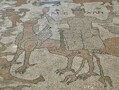
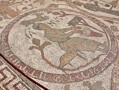
Detail of the mosaic floor of Otranto Cathedral, Italy, 12th century. (For more information about the building, see Paradox Place).
The mosaics depict months of the year and the labour associated with them, signs of the zodiac, and important historic figures. This detail shows Alexander the Great. Mosaics featured prominently in Roman and Byzantine architecture, and it is not surprising to see that this craft tradition was very much alive in 12th century Italy.
© Paradox Place
-
Otranto Cathedral Mosaics
Image of the mosaics of Otranto Cathedral, Italy 12th century. (For more information about the building, see Paradox Place).
© Paradox Place
-
Peterborough Cathedral
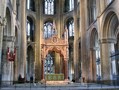
Interior view of Peterborough Cathedral, England, 1118 onwards. (For more information about the building see Paradox Place).
© Paradox Place
-
Priory of Villeneuve d'Aveyron
An eleventh-century apse in the priory of Villeneuve d'Aveyron in France. (For more information see Paradox Place).
The wall paintings (dating from the fourteenth century) depict scenes of pilgrims, a reminder of the importance of religious buildings as places of pilgrimage in medieval times -- a role which Durham shared.
© Adrian Fletcher (www.paradoxplace.com)
-
Doorway in Durham Castle
This 12th century doorway in Durham Castle, bears a resemblance to another at Santiago de Compostela in Spain (see next image). It was constructed by Hugh Le Puiset, who added a similar one in Durham Cathedral.
-
Santiago de Compostela
Entrance to the chapel at Santiago de Compostela, (For more information about the chapel see Paradox Place).
This portal bears strong similarities with two portals in Durham, both constructed under the patronage of Hugh Le Puiset in the late 12th century, one in Durham Castle (previous image) and the other in the cloister of Durham Cathedral (next image).
© Photo of Santiago de Compostela by Adrian Fletcher (www.paradoxplace.com)
-
Prior's Door, Durham Cathedral
This doorway was constructed in the late 12th century by Hugh Le Puiset, who added a similar one in Durham Castle. The resemblance of the stone carving to a doorway at Santiago de Compostela in Spain (previous image) is striking.
© Durham Cathedral and Jarrold Printing
-
St Augustine Church, Brookland, Kent
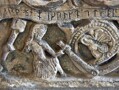
A twelfth-century lead font from St Augustine's Church, Brookland, Kent. (For more information about the building see Paradox Place).
The font shows the signs of the zodiac, and the labours of each month, both popular themes in art and architecture.
© Adrian Fletcher (www.paradoxplace.com)
-
Trani Cathedral
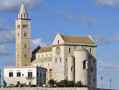
Exterior view of Trani Cathedral, Italy, 1199 onwards. (For more information about the building see Paradox Place).
The fact that Romanesque buildings tended to have small windows is very clear in a building like this, which looks almost defensive.
© Paradox Place
-
Trani Cathedral
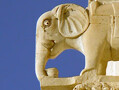
Detail of a corbel at Trani Cathedral, 1099 onwards. (For more information about the building see Paradox Place).
Novelty was something that craftsmen and patrons prized, and even though the buildings of a period or style tend to have things in common, they also have what makes them unique. The elephant carved on this corbel must have been even more eye-catching in the 12th century when it was made than it is today.
© Paradox Place
-
Durham Cathedral Sanctuary Knocker
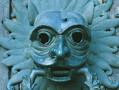
The sanctuary knocker fits in within the Romanesque tradition (see previous and next images), but has a strangely eastern feel to it. It had great political significance: In medieval times, persecuted individuals who required a place of refuge could bang on the knocker and would be given sanctuary in the Cathedral for 37 days.
© Durham Cathedral and Jarrold Printing
-
St Nicholas of Civray
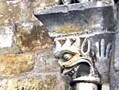
Detail of the exterior stonework of the church of St Nicholas, Civray, France, 12th century. (For more information about the building see Paradox Place).
The two faces on the columns are perhaps among the closest parallels to Durham Cathedral's sanctuary knocker.
© Paradox Place
-
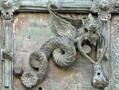
Troia Cathedral Doorknocker
Part of an elaborate bronze door made in 1119, Troia Cathedral, Italy. Unlike the Sanctuary Knocker at Durham Cathedral, the dragon here looks almost friendly. In terms of their concept though, the two knockers have something in common.
© Paradox Place
-
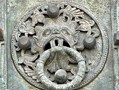
Troia, Detail of Door
The Bronze door of Troia Cathedral was made by Oderiso di Benevento in 1119. The ringed bosses seen here may not have had the same significance as Durham Cathedral's Sanctuary Knocker, seen in the next image, but they are visually similar.
© Paradox Place
-
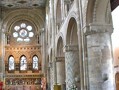
Waltham Abbey
View of the nave of Waltham Abbey, England, mid 12th century. (For more information about this building see Paradox Place).
The abbey is contemporary with the nave of Durham Cathedral, and in fact looks quite similar. The stone for the construction was probably imported from Caen in Normandy, a common practice in Norman times, (though not the case in Durham, where the stone was local).
© Paradox Place
-
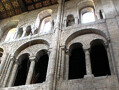
Winchester Cathedral
The transept of Winchester Cathedral, England, 1079 onwards.
Although extensively remodelled, Winchester was originally one of the greatest Norman Cathedrals, and one of the first to synthesise Norman architectural traditions with those of England, Germany and Italy, marking the beginning of the great age of Norman Cathedrals in England, which can be said to culminate with Durham. Upon its original construction, Winchester was one of the largest structures in Christendom. As with Durham, its dimensions are those of the St Peter's in Rome.
© Paradox Place